How to Create an Email Campaign: From Content to Conversion
Email marketing remains a cornerstone of effective digital strategy, providing a direct and personal channel to connect with customers and prospects. However, simply sending out sporadic emails is insufficient for achieving meaningful results. A truly successful approach involves designing and executing well-crafted email campaigns, meticulously planned from initial email content creation through to ongoing email campaign optimization. This comprehensive guide will walk you through each essential stage, empowering you to build email campaigns that not only capture attention but also drive significant engagement and conversions.
The Strategic Importance of Well-Crafted Email Campaigns
A strategic email campaign does more than just disseminate information; it builds relationships, nurtures leads through the sales funnel, promotes products or services effectively, and fosters brand loyalty. Unlike fleeting social media posts, emails offer a dedicated space to convey value and guide recipients towards a desired action. Effective email content creation ensures your message resonates, while rigorous email campaign optimization guarantees you’re continually improving performance and maximizing your return on investment.
Phase 1: Foundational Planning for Your Email Campaign
Before a single word of your email is written, robust planning must occur. This foundational stage sets the direction for your entire campaign.
Defining Clear Campaign Goals
What specific outcomes do you want your email campaign to achieve?
- Examples: Increase online sales by a target percentage, drive a certain number of visitors to a new blog post, generate leads for a new service, promote attendance for an upcoming webinar, gather customer feedback, or announce a significant company update.
- Clearly defined goals will directly influence your target audience, your email content creation strategy, and the key metrics you’ll use to measure success.
Identifying and Segmenting Your Target Audience
Who are you trying to reach with this specific campaign?
- Effective email campaign optimization begins with sending the right message to the right people. Segment your email list based on demographics (age, location), psychographics (interests, lifestyle), purchase history, engagement levels (active vs. inactive subscribers), or specific interests indicated through past interactions. Tailoring messages to well-defined segments dramatically boosts relevance and response rates.
Choosing the Right Email Campaign Type
The nature of your campaign will depend on your goals. Common types include:
- Promotional Campaigns: Highlighting special offers, discounts, new product launches, or seasonal sales.
- Lead Nurturing Series: A sequence of automated emails designed to educate prospects and build trust, gently guiding them towards a purchase decision.
- Newsletters: Regular (e.g., weekly, monthly) updates containing valuable content, company news, industry insights, or curated articles to keep your audience engaged and informed.
- Re-engagement Campaigns: Specifically designed to win back inactive subscribers who haven’t interacted with your emails recently.
- Welcome Email Series: An automated sequence sent to new subscribers to introduce your brand, set expectations, and provide initial value.
- Onboarding Campaigns: Guiding new customers through the initial stages of using your product or service.
Outlining Campaign Content and Sending Cadence
With goals, audience, and campaign type defined, map out the core messages.
- If it’s a series, what is the specific focus of each email? How do they logically connect?
- Determine an appropriate sending frequency (cadence). You want to stay top-of-mind without overwhelming or annoying your subscribers, which could lead to unsubscribes – a key concern for email campaign optimization.
Phase 2: Mastering Email Content Creation for Maximum Impact
This is where your strategic planning translates into compelling communication that captivates your audience and encourages action.
Crafting Irresistible Subject Lines and Preheaders for Better Open Rates
Your subject line is the first, and often only, chance to make an impression.
- Subject Line Best Practices: Keep it concise (ideally under 50 characters), intriguing, and clearly benefit-driven. Use numbers, relevant emojis (sparingly and appropriately), questions, or create a sense of urgency or curiosity. Personalize it with the subscriber’s name where relevant.
- Engaging Preheader Text: This short snippet of text visible after the subject line in many email clients provides a crucial extension. Use it to add context, reinforce the value proposition, or offer a secondary hook. Effective preheaders are a vital part of email content creation.
Developing Engaging and Valuable Email Body Content
Once opened, your email must deliver on the promise of its subject line.
- Clarity, Conciseness, and Value Proposition: Get to the point quickly. Use short sentences, digestible paragraphs, and clear headings. Prominently feature what’s in it for the reader – the core value.
- Personalization and Storytelling Techniques: Address subscribers by name. Leverage dynamic content to tailor specific offers or information based on their segment. Weave in relatable stories or case studies to connect on an emotional level.
- Effective Use of Visuals and Branding: Incorporate high-quality images, GIFs, or videos where appropriate to enhance your message and break up text. Ensure all visuals are optimized for fast loading and that your email remains understandable even if images are blocked. Maintain consistent branding (logo, colors, fonts) to reinforce brand recognition.
Designing Compelling Calls-to-Action (CTAs) that Drive Conversions
Your CTA tells subscribers what you want them to do next.
- CTA Best Practices: Use clear, action-oriented language (e.g., “Shop Now,” “Learn More,” “Download Your Free Guide,” “Register Today”). Make CTAs visually prominent – buttons typically outperform text links. Ideally, focus on one primary CTA per email to avoid decision paralysis.
Ensuring Mobile-Responsive Design for Accessibility
A majority of emails are now opened on mobile devices.
- Your email template must be fully responsive, meaning it adapts seamlessly to look great and function perfectly on all screen sizes (desktops, tablets, smartphones). Most modern email marketing platforms facilitate this, but always test. This is crucial for email campaign optimization.
Essential Footer Information and Legal Compliance
Include legally required and best-practice information in your email footer.
- This typically includes your company’s registered name and physical address (a requirement under laws like CAN-SPAM), a clear and easy-to-find unsubscribe link, and optionally, a link to your privacy policy or preference center.
Phase 3: Email Campaign Optimization for Conversions and Growth
Sending the email is not the end; it’s the beginning of the optimization cycle. Continuous improvement is key.
The Power of A/B Testing for Continuous Improvement
A/B testing (or split testing) is fundamental to email campaign optimization.
- Test one variable at a time to determine what resonates best with your audience. Common elements to test include subject lines, preheaders, CTAs (wording, color, placement), email copy, visuals, send times, and even entire email layouts. Send variations to small, representative segments of your list, then roll out the winning version to the larger audience.
Strategic List Segmentation and Hygiene Practices
Refining your audience targeting and maintaining a healthy list are ongoing tasks.
- Advanced Segmentation: Continuously analyze subscriber data to create more granular segments for hyper-personalized messaging.
- List Hygiene: Regularly clean your email list by removing hard bounces, unengaged subscribers (after re-engagement attempts), and those who consistently mark your emails as spam. This improves your sender reputation, deliverability, and overall campaign metrics.
Monitoring Key Email Marketing Metrics for Performance Insights
Track and analyze these metrics to understand campaign performance:
- Open Rate: Percentage of recipients who opened your email. Indicates subject line effectiveness and audience interest.
- Click-Through Rate (CTR): Percentage of recipients who clicked on one or more links within your email. Shows content relevance and CTA effectiveness.
- Conversion Rate: Percentage of recipients who completed the desired action after clicking (e.g., made a purchase, filled out a form). Measures the ultimate success of your campaign in achieving its goals.
- Bounce Rate: Percentage of emails that were not delivered. Distinguish between hard bounces (permanent delivery failures, e.g., invalid address) and soft bounces (temporary issues).
- Unsubscribe Rate: Percentage of recipients who opted out of future emails. Monitor this closely; high rates can indicate content irrelevance, excessive frequency, or list fatigue.
Iterating Based on Data and Performance Analysis
Use the data gleaned from your metrics to make informed decisions.
- Identify trends, understand what content formats or offers perform best for different segments, and don’t be afraid to experiment. Refine your email content creation and targeting strategies based on these insights.
Key Deliverability Factors for Successful Campaigns
Ensuring your emails actually reach the inbox is paramount.
- Authenticate your sending domain (using SPF, DKIM, and DMARC records) to build trust with ISPs.
- Avoid using spam trigger words in subject lines and body copy.
- Maintain a consistent sending schedule and volume.
- Encourage engagement, as positive interactions signal to ISPs that your emails are valued.
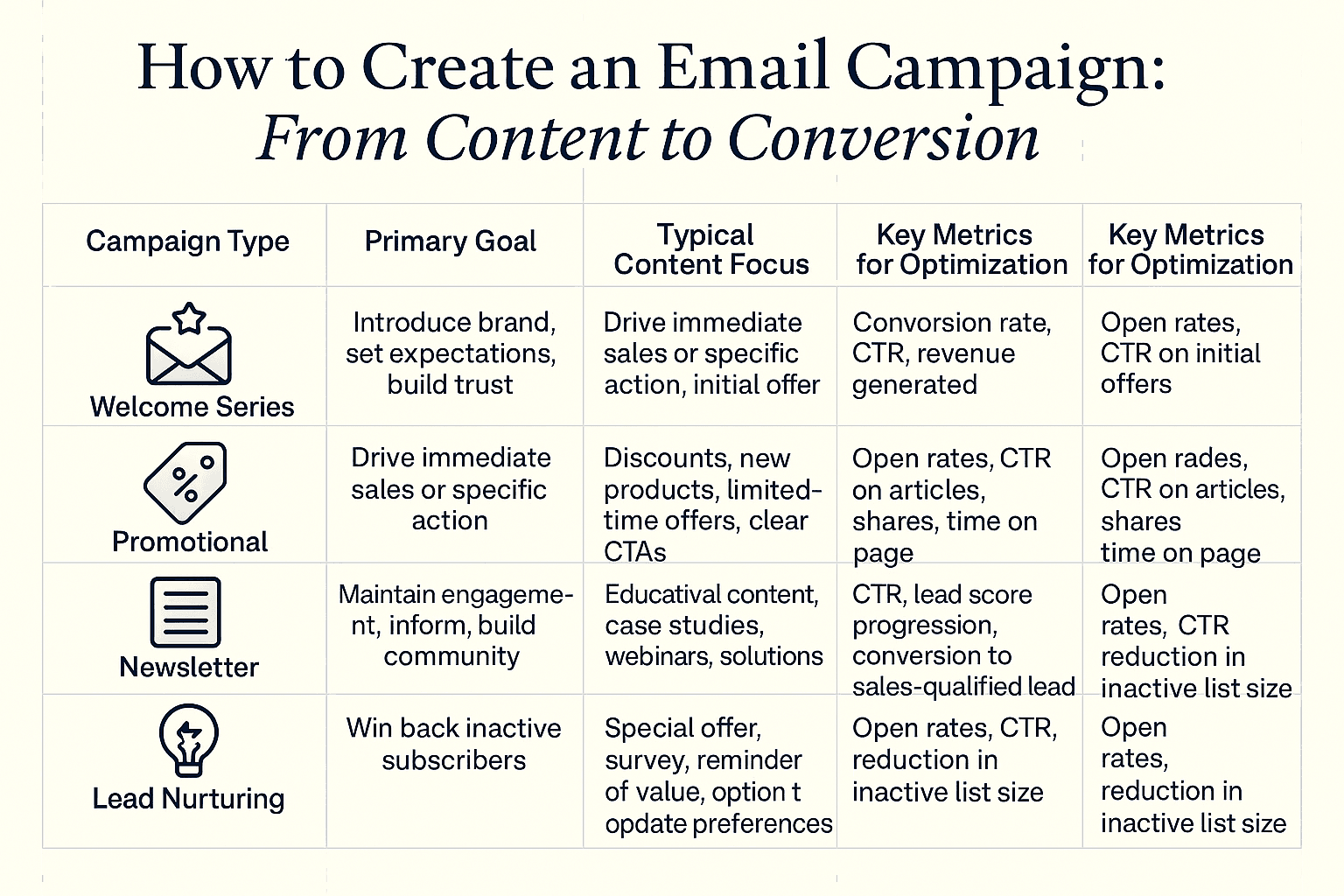
Comparison of Common Email Campaign Types
| Campaign Type | Primary Goal | Typical Content Focus | Key Metrics for Optimization |
|---|---|---|---|
| Welcome Series | Introduce brand, set expectations, build trust | Brand story, value proposition, key resources, initial offer | Open rates, CTR on initial offers, engagement over series |
| Promotional | Drive immediate sales or specific action | Discounts, new products, limited-time offers, clear CTAs | Conversion rate, CTR, revenue generated |
| Newsletter | Maintain engagement, inform, build community | Valuable content, industry news, company updates, tips | Open rates, CTR on articles, shares, time on page |
| Lead Nurturing | Educate prospects, build relationships, move to sale | Educational content, case studies, webinars, solutions | CTR, lead score progression, conversion to sales-qualified lead |
| Re-engagement | Win back inactive subscribers | Special offer, survey, reminder of value, option to update preferences | Open rates, CTR, reduction in inactive list size |
Crafting and managing successful email campaigns requires strategic thinking and attention to detail. For instance, choosing the right platform is an early step; you might consider various cheap email marketing tools under $10/month (Link was lost here) if budget is a key concern. Similarly, if your campaigns involve large volumes, understanding top free email sender tools for businesses (Link was lost here) can be beneficial. And of course, ensuring your fundamental email address appears professional, even if it’s a free business email without a domain (Link was lost here), sets the right tone from the start.
Conclusion: Transforming Email Campaigns into Conversion Engines
Creating an effective email campaign is a dynamic and iterative process, blending artful email content creation with scientific email campaign optimization. By diligently following these phases—from meticulous planning and compelling content development to rigorous testing and data-driven refinement—you can transform your email marketing efforts from simple broadcasts into powerful engines that drive engagement, nurture relationships, and achieve significant conversions for your business.